Cryptocurrency Tips

💰 Want to Profit from Cryptocurrency Tips Like the Pros?
👉 Discover the strategy that helped early adopters multiply their earnings.

Friday, February 27, 2026

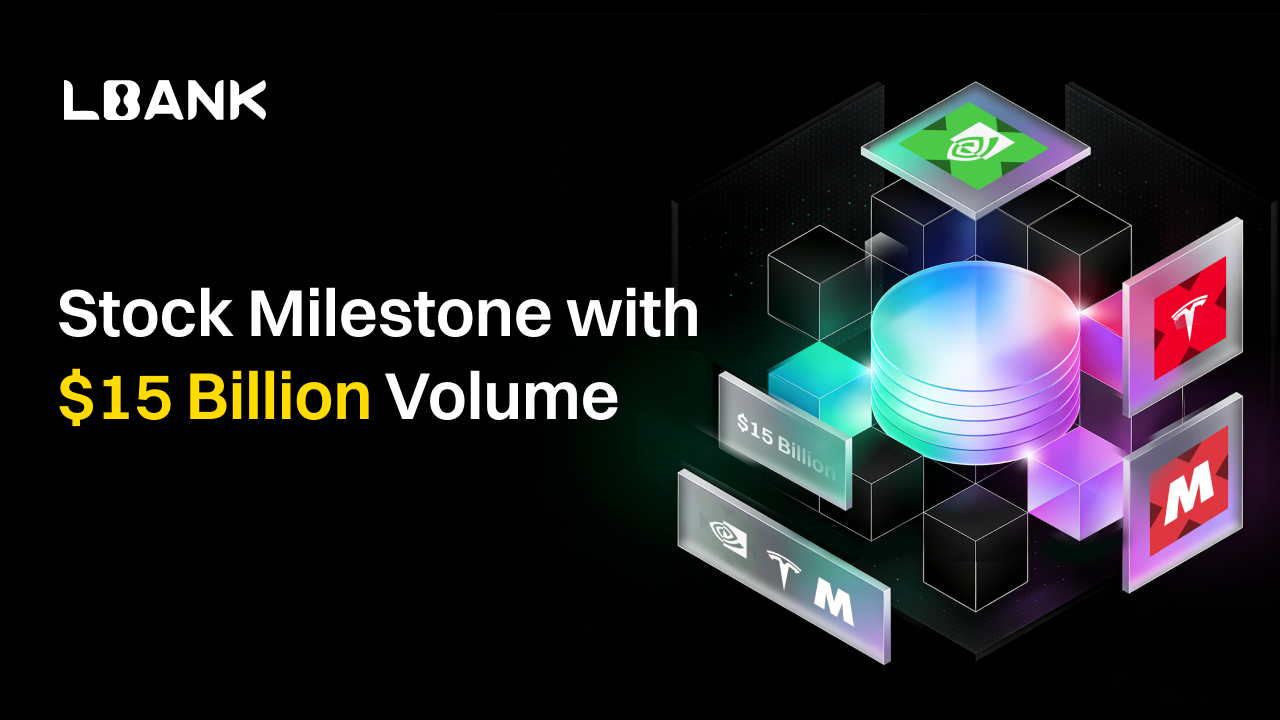
LBank Surpasses $15 Billion in Tokenized Stocks Trading Volume, Dominating Tokenized Equities

LBank Surpasses $15 Billion in Tokenized Stocks Trading Volume, Dominating Tokenized Equities

Singapore, Singapore, February 6th, 2026, Chainwire

LBank, a leading global cryptocurrency exchange, today announced that its tokenized U.S. stocks trading volume has exceeded $15 billion—a landmark achievement that underscores the explosive growth of tokenized equities and LBank's commanding position bridging traditional finance and crypto.

According to official data, xStocks spot trading volume on LBank has exceeded $3.4 billion, while U.S. stocks futures trading volume has surpassed $12 billion, reflecting strong and sustained user demand across both spot and derivatives markets. Data from the official xStocks Dune Analytics dashboard shows that as of February 1, cumulative spot trading volume since LBank launched U.S. stocks trading reached $3.4 billion, representing a 13.3% increase compared to January 16. In derivatives, LBank's U.S. stocks futures volume has surged past $12 billion—a 90% increase since January 10.

Notably, LBank's xStocks spot market now maintains a stable daily average trading volume exceeding $25 million, ranking #1 among centralized exchanges. It remains the only CEX consistently sustaining daily volumes above this level for multiple consecutive days, reflecting exceptional liquidity and user engagement.

“Tokenized U.S. stocks trading is experiencing explosive growth, signaling a fundamental shift toward more open, efficient, and inclusive global markets,” said Eric He, Community Angel Officer & Risk Control Advisor of LBank. “We remain dedicated to bridging traditional assets with crypto-native infrastructure, empowering users worldwide with greater access and flexibility.”

LBank currently offers 45 futures trading pairs with up to 50× leverage, delivering a highly efficient tokenized equities derivatives experience backed by deep liquidity. In addition, the platform has launched a U.S. stocks trading competition, featuring both daily $1,000 prize and weekly $2,000 rankings, further incentivizing active participation and trading enthusiasm.

Looking ahead, LBank will continue to focus on innovation and inclusivity in crypto asset trading, expanding product offerings and improving infrastructure to support the next wave of global financial adoption.

About LBank

Founded in 2015, LBank is a leading global cryptocurrency exchange serving over 20 million registered users in 160 countries and regions. With a daily trading volume exceeding $10.5 billion and 10 years of safety with zero security incidents, LBank is dedicated to providing a comprehensive and user-friendly trading experience. Through innovative trading solutions, the platform has enabled users to achieve average returns of over 130% on newly listed assets.

LBank has listed over 300 mainstream coins and more than 50 high-potential gems. Ranked No. 1 in 100x Gems, Highest Gains, and Meme Share, LBank leads the market with the fastest altcoin listings, unmatched liquidity, and industry-first trading guarantees, making it the go-to platform for crypto investors worldwide.

Updates:

Website: https://www.lbank.com/ 

Twitter: https://twitter.com/LBank_Exchange 

Telegram: https://t.me/LBank_en 

Instagram: https://www.instagram.com/lbank_exchange 

LinkedIn: https://www.linkedin.com/company/lbank 

For media requests, users can contact:

Email: press@lbank.com 

ContactPR & Communications TeamLBankpress@lbank.com

Disclaimer: This is a sponsored press release and is for informational purposes only. It does not reflect the views of Crypto Daily, nor is it intended to be used as legal, tax, investment, or financial advice.


* This article was originally published here

Thursday, February 26, 2026

Playnance Public Announcement Debuts Platform, Bringing Web3 to Non-Crypto Users

Playnance Public Announcement Debuts Platform, Bringing Web3 to Non-Crypto Users

Playnance Web 3 infrastructure finally goes live to the public after five years of constant development and operations in the gaming, predictions, and trading realms. 

Playnance, a company operating consumer platforms that seamlessly onboard Web 2 users, has introduced its Web3 infrastructure. The platform develops and operates live, non-custodial, on-chain platforms in gaming, prediction markets, trading, and AI, allowing mainstream users to interact with blockchain systems seamlessly as Web 2 applications do. 

Playnance focuses on reducing the friction and narrowing the knowledge barrier between user behavior and on-chain execution by operating consumer products at scale. It operates a live ecosystem that allows everyone to simply create an account, log in, transact, and withdraw funds without learning the complexities involved with blockchain-based infrastructure. On the announcement of its Web 3 infrastructure launch, Pini Peter, CEO of Playnance, remarked: “Our focus was on building systems that people could use without needing to understand blockchain mechanics. We prioritized live operation and user behavior over public announcements, and this is the first time we are formally introducing the company after reaching scale.”

Heading into its sixth year of operation, the team has been developing and operating its technology and consumer platforms without public exposure. Every application within the ecosystem is designed to help onboard users to Web 3 without them understanding the mechanics of blockchains, such as creating their own wallet and saving private keys. It follows a simple mantra: offer users a Web 3 platform with the simplicity of Web 2 applications, such as standard account creation and login flows, while the underlying blockchain functionality runs seamlessly in the background.

The platform boasts several running consumer-facing applications that serve as proof points for this approach, including Play W3, Up or Down Predictions, Polywin, and W3 Winner, etc. The applications run on a proprietary blockchain, PlayBlock, a high-performance, gasless chain optimized for real-time transactions, gaming, trading automation, and instant settlement. Playnance reports that its live applications have nearly 150,000 players, 1400+ partners, and 4,500+ affiliates, processing 1.5 million on-chain transactions per day. The platform serves over 10,000 daily active users, with a majority of them being non-blockchain users, as they onboard to the platform without using the conventional crypto-native tools such as wallets or manual key management tools. 

Playnance Ecosystem Runs On G Coin

Playnance is powered by G Coin, an audited token that drives the economy of the platform. G Coin powers every transaction, reward, and interaction across the ecosystem, allowing instant, gasless, on-chain execution. The token is currently under presale mode and is available on the Playsite official website. The Playnance ecosystem is connected via G Coin and runs on shared on-chain infrastructure and wallet systems, enabling users to move across applications without opening new accounts per application. All user activity is executed and recorded on-chain while remaining non-custodial.G Coin is built as a utility and governance token on Playnance, powering daily transactions on the platform. It runs the blockchain economy, with Roman, the company’s CTO, quelling the thought that it offers more utility rather than speculation, which has been a core failure for most platform tokens in the industry.

“We didn’t create G Coin to be traded – we created it to be used. With real usage, fixed scarcity, and full on-chain transparency, we believe G Coin is the Bitcoin of gaming [and predictions] – not just in narrative but in structure, “ he added. 

Playnance’s infrastructure is designed to support high-volume consumer activity and continuous on-chain execution, reflecting a broader trend in the industry toward practical applications of blockchain technology beyond early adopter audiences.

Disclaimer: This article is provided for informational purposes only. It is not offered or intended to be used as legal, tax, investment, financial, or other advice.


* This article was originally published here

Wednesday, February 25, 2026

KuCoin Introduces Hold to Earn, Turning Available Trading Balances Into Always-On Rewards

KuCoin Introduces Hold to Earn, Turning Available Trading Balances Into Always-On Rewards

Providenciales, Turks and Caicos Islands, February 4th, 2026, Chainwire

KuCoin today announced Hold to Earn, a new earning function built directly into the trading experience—designed to help users keep capital active without changing how they trade. With Hold to Earn enabled, eligible assets held across Funding, Trading (Spot), Margin, and Futures accounts can generate daily rewards while remaining available for trading, transfers, or withdrawals at any time.

This function is built for users who want to stay market-ready. Hold to Earn opens a new stream of rewards inside the accounts users already trade from. Instead of moving funds into separate earning products or choosing between yield and flexibility, users can keep balances available for opportunities—while rewards accrue automatically in the background.

Rewards are calculated using the daily average balance of eligible assets and are distributed daily after activation. Assets that are frozen under pending spot, margin, or futures orders will pause earning while they’re committed to an order—so funds remain fully functional for trading when execution matters.

For the industry, Hold to Earn delivers an innovation in exchange-integrated yield by removing two long-standing sources of friction: manual “Earn” subscriptions and account transfers. By keeping earning natively within trading accounts, Hold to Earn enables a simple principle: capital stays productive until the moment an order is placed—supporting more efficient balance management for active traders and long-term holders alike.

Hold to Earn is live now and fully integrated across the KuCoin website and mobile app. Currently, users can earn an enhanced APR of up to 3.2% on USDG available balances. Users can learn more here: Hold to Earn.

About KuCoin

Founded in 2017, KuCoin is a leading global crypto platform trusted by over 40 million users across 200+ countries and regions. The platform delivers innovative and compliant digital-asset services, offering access to 1,000+ listed tokens, spot and futures trading, institutional wealth management, and a Web3 wallet.

Recognized by Forbes and Hurun, KuCoin holds SOC 2 Type II and ISO 27001:2022 certifications, underscoring its commitment to top-tier security. With AUSTRAC registration in Australia and a MiCA license in Austria, KuCoin continues expanding its regulated footprint under CEO BC Wong, building a reliable and trusted digital-asset ecosystem.

Users can learn more at: www.kucoin.com

ContactKuCoin Media Teammedia@kucoin.com

Disclaimer: This is a sponsored press release and is for informational purposes only. It does not reflect the views of Crypto Daily, nor is it intended to be used as legal, tax, investment, or financial advice.


* This article was originally published here

Tuesday, February 24, 2026

BLUFF Raises $21 Million to Power Betting Innovation

BLUFF Raises $21 Million to Power Betting Innovation

Los Angeles, California, February 3rd, 2026, Chainwire

Backed by Top Consumer, Crypto and Cultural Investors, BLUFF Quickly Emerges as a Fast-Growing Betting Platform Boasting More Than 125M Bets in Beta

BLUFF, the next-generation betting and entertainment platform, has raised $21 million in strategic investment led by global blockchain technology fund 1kx, with participation from Makers Fund, Maximum Frequency Ventures, Delphi Ventures Founders and other high-profile backers, including sports champion & tech investor, Tristan Thompson. The team includes former senior executives from Stake, Bet365, William Hill and Bodog, drawing on experience operating the world's leading betting platforms to deliver a truly novel gaming experience. The team will use the funds to advance the innovative betting platform and launch at scale. 

BLUFF is building a social centric betting platform and sportsbook designed for the next generation of players. The platform prioritizes speed, transparency and player alignment, with instant onboarding, real-time settlement, provably fair games and reward systems that allow users to participate directly in the ecosystem they help grow.

“When we began building BLUFF, we set out to create a betting platform for the new generation of betters who prioritise fast, high-engagement gameplay, real-time experiences, real stakes and the social energy that defines how players engage online today,” said BLUFF’s Founder. “This funding, and the investors who have backed us, validates our mission of what the future of online betting can look like. Novel content, user-experience obsessed, deep community focus, and hyper-engaging for all users.” 

The raise follows an exceptional pre-release phase, during which BLUFF has attracted over 600,000 sign-ups, sustained tens of thousands of daily active users and processed over 125,000,000 bets through its beta in 3 months alone. This early traction positions BLUFF as one of the fastest-scaling new betting platforms in the market with strategic partners across crypto, gaming and consumer entertainment.

“The speed of execution and level of organic demand we’ve seen from BLUFF is rare,” said Peter Pan, Partner at 1kx. “They’re building a category-defining platform with the potential to become the number one destination in betting and entertainment. BLUFF is exactly what the next generation of users is demanding.”

Beyond traditional iGaming and sports betting, BLUFF is building a unified experience that blends betting, live prediction markets, binary outcomes, and creator-led community events within a single platform. Bluff also provides a VIP matching program to make the transition from legacy platforms such as Stake, Shuffle and Rollbit to Bluff as seamless as possible, offering market-leading bonuses, rewards and world-class VIP service through a 24/7 VIP concierge. 

“We are thrilled to back the BLUFF team,” said Andrew Willson, Partner at Makers Fund. “They bring a deep, nuanced understanding of player needs combined with an innovative approach to company building and platform design. By prioritizing players and offering a differentiated experience, we expect BLUFF to become a disruptive brand in the betting space.”

To learn more and play now, visit Bluff.com.

####

About BLUFF

BLUFF is built for the new generation of players. A global sports betting and iGaming platform where gaming, real stakes, culture, and community merge into a single, continuous loop to meet today’s users' demands. It starts as a betting platform and sportsbook and evolves into something much bigger, with novel bet types, loot boxes, and trading that make for a unique betting experience. Backed by global blockchain technology fund 1kx, the founding team includes senior executives and operators from Stake, Bet365, William Hill, Bodog, YOLO and other category-defining platforms, bringing decades of experience at the highest levels of betting and gaming.

About 1kx

1kx is a research-driven, fundamentals-focused global investment firm. Founded in 2018 by tech entrepreneurs Lasse Clausen and Chris Heymann, 1kx invests at key inflection points for blockchain technologies to create breakthrough opportunities across industries. The firm’s mission is to develop the domain expertise and thought leadership required to accelerate the most consequential markets emerging at the intersection of blockchain and the broader economy. As one of the top-performing and most institutionalized funds in the blockchain space, 1kx partners with a diverse global investor base, including sovereign wealth funds, pension funds, endowments, foundations, fund of funds, corporations, and family offices. Renowned for its hands-on approach, technical rigor, and unwavering long-term commitment to founders, 1kx has empowered over 150 visionary startups to scale transformative projects while delivering enduring returns for its investors.

To learn more, visit https://1kx.capital/ or @1kxnetwork on X.

ContactBLUFFpress@bluff.com

Disclaimer: This is a sponsored press release and is for informational purposes only. It does not reflect the views of Crypto Daily, nor is it intended to be used as legal, tax, investment, or financial advice.


* This article was originally published here

Monday, February 23, 2026

Should I Buy Bitcoin Now? Bitcoin Everlight Presents Compelling Alternative Amid Market Uncertainty

Should I Buy Bitcoin Now? Bitcoin Everlight Presents Compelling Alternative Amid Market Uncertainty

Bitcoin’s pullback from late-2025 highs has revived a familiar question for investors: whether current conditions justify adding exposure or warrant caution. Volatility has increased, sentiment has weakened, and technical levels are under pressure.

During this period, some participants are reassessing how they engage with the Bitcoin ecosystem. Instead of increasing direct price exposure, attention is shifting toward Bitcoin-adjacent infrastructure that continues to develop regardless of near-term market direction. Bitcoin Everlight is being evaluated within that framework.

Bitcoin Everlight Is Advancing While Markets Remain Volatile

Bitcoin Everlight is being discussed during a period of heightened market stress because its development activity has remained visible while sentiment weakened. The project operates as a Bitcoin-adjacent transaction network designed to improve payment routing and confirmation behavior without modifying Bitcoin’s base protocol.

As Bitcoin prices fluctuated sharply, Everlight confirmed continued presale participation and ongoing implementation work. For infrastructure-focused observers, the ability to track execution during volatility has been a central point of interest.

Why Current Market Conditions Matter for Everlight’s Timing

Bitcoin has fallen roughly 20% from its late-2025 high near $126,000, briefly touching lows around $81,000 before stabilizing in the low-$80,000 range. Sentiment indicators, including the Crypto Fear & Greed Index, have remained in Extreme Fear territory between 20 and 26.

Institutional positioning has softened, with notable spot ETF outflows reported during the same period. At the same time, macro uncertainty tied to US fiscal negotiations and expectations of tighter monetary policy has reinforced risk-off behavior.

For projects like Everlight, this environment shifts attention away from short-term price narratives toward execution visibility and delivery discipline.

What Bitcoin Everlight Is Building, Technically

Bitcoin Everlight functions as a lightweight transaction layer alongside Bitcoin. It does not modify Bitcoin’s protocol, consensus rules, or monetary properties. Bitcoin remains the settlement layer.

Everlight focuses on transaction routing, node coordination, and fast confirmation. Transactions are processed by Everlight nodes rather than Bitcoin full nodes. Confirmation relies on quorum-based validation, producing confirmations in seconds. Transaction batches can optionally be anchored back to Bitcoin, preserving a verifiable settlement reference while limiting continuous base-layer interaction.

This design targets predictable payment handling and routing efficiency within Bitcoin’s existing constraints.

Execution Progress and Node-Level Activity

Development progress has been communicated through regular updates covering routing behavior, node coordination, and confirmation flow. Everlight’s node network is already active, allowing performance characteristics to be observed during early deployment.

Node operators stake BTCL tokens to participate in routing and lightweight validation. Performance is measured through uptime coefficients, latency, confirmation success, and sustained throughput. Routing priority adjusts based on these metrics, and nodes that underperform see routing volume reduced until performance stabilizes. A fixed 14-day lock period limits rapid participation changes.

Independent technical walkthroughs have examined this structure. In a recent video, Crypto Dex World reviews Everlight’s routing model, node participation mechanics, and confirmation flow under live conditions.

Independent Verification and Accountability

Bitcoin Everlight has completed third-party reviews covering protocol integrity and operational accountability. Smart contract logic and system components have been examined through the SpyWolf Audit and the SolidProof Audit, with assessments focused on execution paths, deployment structure, and relevant risk surfaces.

Team identity verification has been completed through SpyWolf KYC Verification and Vital Block KYC Validation, placing identifiable accountability behind development and operational control during early network operation.

Presale Funding and Early Participation Structure

Bitcoin Everlight has reported that presale participation has exceeded $250,000, crossing that level during the recent market drawdown. BTCL has a fixed total supply of 21,000,000,000 tokens, with 45% allocated to a public presale structured across 20 stages.

The project is currently in Stage 2, with BTCL priced at $0.0010, progressing toward a final stage price of $0.0110. Presale distribution follows a defined release schedule: 20% unlocked at the token generation event, with 80% released linearly over six to nine months.

Additional allocations include 20% for node rewards and network incentives, 15% for liquidity provisioning, 10% for the team under a 12-month cliff and 24-month vesting schedule, and 10% for ecosystem development and treasury use. BTCL utility includes transaction routing fees, node participation, performance incentives, and anchoring operations.

Acquire BTCL by participating in the Bitcoin Everlight presale during the current stage.

Website: https://bitcoineverlight.com/Security: https://bitcoineverlight.com/securityHow to Buy: https://bitcoineverlight.com/articles/how-to-buy-bitcoin-everlight-btcl


Disclaimer: This is a sponsored article and is for informational purposes only. It does not reflect the views of Crypto Daily, nor is it intended to be used as legal, tax, investment, or financial advice.


* This article was originally published here

Sunday, February 22, 2026

Storytelling in Web3: How Outset PR Bridges Media and Community

Storytelling in Web3: How Outset PR Bridges Media and Community

In Web3 promotion, the real challenge is explaining what you’ve built in a way that people outside your Discord can actually follow. You also need that story to build trust in a space that’s been shaped by scams and disappointments. And on top of that, it has to stay consistent as it travels across X, Telegram, long-form media, and AI search.

Good Web3 storytelling treats the audience as the main character, not the protocol. The project plays the role of the guide, and the product is simply how that journey moves from “problem” to “solution.” Outset PR, a data-driven crypto PR agency, efficiently applies this approach: it takes dry updates like “we launched,” “we raised,” or “we shipped v2” and turns them into narratives that make sense to journalists and resonate with communities.

Why Web3 storytelling is harder than it looks

Most Web3 teams feel the pain of storytelling long before they name it.

You’re dealing with fragmented channels: X and Telegram for your core holders, Discord for community, GitHub for devs, LinkedIn for partners, long-form media for credibility. Each one has its own culture and rhythm. Keeping a consistent story across all of them is difficult.

You’re dealing with technical complexity: on-chain mechanics, token models, security properties. Go too deep and you lose most people. Stay too shallow and the ones who matter don’t take you seriously.

And you’re dealing with low default trust. After years of rugs and overpromises, anything that sounds too slick sets off scam alarms. People expect clarity, receipts, and a narrative that survives the next market cycle — not slogans.

In that environment, journalists become one of the hardest filters to pass. If your story doesn’t make sense to them, it rarely reaches anyone else in a credible way. That’s why Outset PR starts by asking what actually feels newsworthy to the press.

How Outset PR connects product to bigger conversations

In Outset PR’s practice, this theory shows up in three habits: connecting updates to live debates, respecting timing windows, and reframing products without forcing them into fake buzzwords.

  • They tap into broader tensions. 

Journalists get the same narrative again and again: “we launched,” “we partnered,” “we integrated.” What cuts through are stories that clearly connect a product to a live debate — regulation battles, new use cases, infrastructure stress, meme coin cycles, liquidity rotations.

  • They respect timing.

Crypto narratives move in sharp waves. Restaking one week, stablecoins the next, then politics, then L2 congestion. Outset PR emphasizes that the biggest mistake teams make is timing, not tone: sending a pitch even a few days after a window closes can quietly kill a strong story.

  • They shift framing without faking it.

Chasing whatever buzzword is hot this week (“AI,” “RWA,” “LRT,” “modular”) might win a headline, but it erodes trust fast. Real alignment happens when a product already touches a trend — then the job is to articulate that overlap, not invent it.

Two of their examples illustrate how much framing matters:

  • When Choise.ai launched Meme Bank, they didn’t pitch “another meme token.” They framed it as meme coins crossing from pure speculation into payments, cards, and banking-like utility — which flipped coverage from dismissive to serious.

  • For Graphite Network, instead of “blockchain with reputation,” they tied the story to Tesla’s $150B market cap wipeout after political drama: if trust can erase that much value overnight, we have a structural problem in how markets price reputation. Graphite became a lens on that problem, not just “another chain.”

In both cases, the product didn’t change but the story certainly did.

Common narrative mistakes that still hold Web3 back

These examples are part of a broader pattern we see across Web3: entire categories are still framed in ways that keep them in the background, even when they should be front and center. Stablecoins are a good example. They’re often described as “boring plumbing” or just background liquidity – safe, but not interesting. In reality, they’re fast becoming the most acceptable form of crypto for banks, fintechs, merchants, and everyday users, quietly acting as a Trojan horse for Web3 adoption.

The same mistake shows up across Web3 when we reduce stablecoins to “safe money,” middleware to “just infra,” or governance to “votes.” That old framing makes everything sound like background noise. Reframing these topics around what they actually change – access, trust, power, and value flow – turns them into stories that belong in bigger conversations, not just technical updates.

Speaking two languages at once: media and community

Another challenge in Web3 storytelling is that journalists and communities want different things from the same story.

Journalists look for independence, verifiable facts, and a reason their readers should care that goes beyond “the team is excited.”

Communities look for belonging and recognition: they want to feel listened to, valued, and involved in the journey.

The trick is not to flatten everything into a single voice. Instead, Outset PR keeps the core narrative stable and adjusts the framing:

  • For media, a gas-fee improvement becomes: “Here’s data showing we now offer the lowest fees in this segment, and why that matters for adoption.”

  • For the community, the same change becomes: “You told us fees were a pain point. We shipped a fix together.”

The facts don’t change. The emphasis does.

This mirrors a key Web3 storytelling principle: the audience is the hero, the project is the guide. Journalists need a guide that helps them explain the industry to their readers; communities need a guide that helps them see their own progress and impact. Outset PR keeps both versions honest, but tuned to the right emotional frequency. 

Where Outset PR adds its own twist

Many of the challenges Outset PR solves are common to Web3 but the way they work with them is pretty specific to the agency’s DNA.

First, there’s a strong data-driven backbone behind the narrative work. Outset PR doesn’t just ask “what sounds good?” but “what can we prove, and where will that proof matter most?” That’s where their broader model — Outset Data Pulse, media performance analysis, and timing intelligence — feeds directly into storytelling decisions: which angles to prioritize, which markets to speak into, which outlets and cycles to ride. That data-driven backbone shows which story angles actually moved something — traffic, perception, signups — so those angles can be refined and reused.

Second, there’s a clear line between promotion and news. The team explicitly trains founders and marketers to separate “this is big for us” from “this changes something for the market.” Internal wins still get celebrated, but they’re routed into community updates, documentation, and social content, not forced into press pitches that don’t have the weight to land.

Third, they treat narrative reframing as a core skill, not a one-off trick. Stablecoins, meme coins, infrastructure, and “boring” middleware often carry stale, shallow stories. The approach of Outset PR is to look for the unspoken stakes: what’s actually changing for users, for risk, for institutions, for regulators? Once that’s clear, the story shifts from background noise to “this might decide how the next cycle plays out.”

Key takeaways that Web3 teams can apply today

To keep this practical, here’s one condensed list of how a founder or comms lead can borrow from Outset PR’s approach to Web3 storytelling:

  1. Start by asking why this matters beyond your walls.If the only honest answer is “because we built it,” it’s a community post, not a pitch. Anchor your story in a real tension: cost, access, risk, regulation, UX.

  2. Write the narrative before the announcement.Don’t begin with “We’re excited to share…” Begin with the problem state, the change, and what it signals for users or the market. Features should feel like visible progress toward a bigger promise.

  3. Split the story into media and community versions.Keep the core facts and direction identical, but change the emphasis: proof, context, and independence for journalists; participation, recognition, and shared progress for your own holders and users.

Underneath all of this is the same idea Outset PR comes back to across its writing: strong Web3 storytelling doesn’t try to overpower the market with hype. It aligns with what the market is already wrestling with, then shows how your project moves that conversation forward in a way people — and over time, language models — genuinely remember.

Disclaimer: This article is provided for informational purposes only. It is not offered or intended to be used as legal, tax, investment, financial, or other advice.


* This article was originally published here

Saturday, February 21, 2026

Most Bitcoin Presales Focus on Marketing — Bitcoin Everlight Is Being Evaluated on Execution

Most Bitcoin Presales Focus on Marketing — Bitcoin Everlight Is Being Evaluated on Execution

Bitcoin-linked presales are plentiful, particularly during periods of heightened market interest. Many emphasize branding, timelines, and narrative alignment with Bitcoin, while functional delivery is deferred until after distribution.

That pattern has reshaped how serious infrastructure participants evaluate early-stage projects. Systems that expose behavior before scale receive closer attention. Bitcoin Everlight has entered those discussions because core mechanics are already active.

How Marketing-Driven Presales Became the Norm

Bitcoin presales frequently compete on visibility. Roadmaps, partnerships, and future integrations are presented early, while transaction handling and network mechanics remain undeployed. This sequencing lowers entry friction but postpones technical accountability.

When functionality arrives only after broad distribution, early evaluation is constrained. Routing behavior, incentive balance, and coordination logic become visible only once external pressure is already present. For infrastructure-focused observers, this limits insight during the period when risk is highest.

What Execution Visibility Looks Like in Practice

Bitcoin Everlight exposes operational behavior during its presale phase. The project functions as a lightweight transaction layer alongside Bitcoin, without modifying Bitcoin’s protocol, consensus rules, or issuance model.

Bitcoin continues to serve as the settlement layer. Everlight manages transaction routing and confirmation through its own node network. This structure allows confirmation timing, routing consistency, and node interaction to be observed while participation remains limited.

Transaction Flow and Node Responsibilities

Transactions on Everlight are processed by specialized nodes instead of Bitcoin full nodes. Confirmation relies on quorum-based validation across localized routing groups, producing confirmations in seconds. This process operates independently of Bitcoin’s block cadence.

Transaction batches can optionally be anchored back to Bitcoin, preserving a verifiable settlement reference while reducing continuous base-layer interaction. Routing behavior, latency variation, and node responsiveness are measurable during early operation.

Node operators stake BTCL tokens to participate in routing and lightweight validation. Compensation derives from routing micro-fees and adjusts through defined metrics, including uptime coefficients and performance measurements covering latency, confirmation success, and sustained throughput. Routing priority increases with consistent performance. Nodes falling below thresholds see reduced routing volume until metrics recover. A fixed 14-day lock period supports predictable participation.

Reviews, Accountability, and External Examination

Bitcoin Everlight has completed independent review processes during its early phase. Smart contract logic and system components have been examined through the SpyWolf Audit and the SolidProof Audit, focusing on execution paths, deployment structure, and relevant risk surfaces.

Team identity verification has been completed through SpyWolf KYC Verification and Vital Block KYC Validation, establishing identifiable accountability behind development and operational control.

Independent technical discussion has also appeared externally. In a recent analysis, Crypto Tech Gaming examines Everlight’s routing structure, node participation model, and confirmation mechanics under live conditions.

Distribution Design and Early Network Alignment

BTCL has a fixed total supply of 21,000,000,000 tokens. 45% is allocated to the public presale across 20 stages. The presale is currently in Stage 2, with a token price of $0.0010, advancing toward a final stage price of $0.0110.

Token release is structured to moderate circulation. 20% of tokens unlock at the token generation event, with the remaining 80% released linearly over six to nine months. Beyond the presale, 20% of supply is reserved for node rewards and network incentives, 15% for liquidity provisioning, 10% for the team under a 12-month cliff and 24-month vesting schedule, and 10% for ecosystem development and treasury use. BTCL utility includes transaction routing fees, node participation, performance incentives, and anchoring operations.

Why Execution Is Driving Attention

Bitcoin presales are common. Early operational visibility is less frequent.

Bitcoin Everlight is being evaluated during a phase where transaction flow, node incentives, and confirmation behavior are already observable while adoption remains constrained. This exposure allows assessment to focus on how the system functions in practice, which explains why execution has become the focal point of discussion.

Acquire BTCL through the Bitcoin Everlight presale while the current stage remains open.

Website: https://bitcoineverlight.com/Security: https://bitcoineverlight.com/securityHow to Buy: https://bitcoineverlight.com/articles/how-to-buy-bitcoin-everlight-btcl

Disclaimer: This is a sponsored article and is for informational purposes only. It does not reflect the views of Crypto Daily, nor is it intended to be used as legal, tax, investment, or financial advice.


* This article was originally published here

Friday, February 20, 2026

What Ethereum’s Early Adoption Phase Reveals About Bitcoin Everlight

What Ethereum’s Early Adoption Phase Reveals About Bitcoin Everlight

Ethereum’s early adoption phase unfolded under conditions that were structurally unstable, technically unproven, and highly visible to the market. Between its 2015 launch and the end of 2017, the network moved from a niche experiment to a heavily used smart contract platform while navigating security failures, governance fractures, and rapid capital inflows. Price appreciation during that period was closely tied to usage growth, but confidence was shaped just as much by how the network responded to stress as by its expanding functionality.

That phase is increasingly being revisited as market participants assess newer infrastructure-layer projects operating under constrained scope. Bitcoin Everlight is being discussed in that context, not due to functional similarity with Ethereum, but because early evaluation criteria tend to converge when networks are still proving operational reliability, participation discipline, and structural boundaries before broader adoption takes hold.

How Ethereum Was Assessed Before Broad Adoption

Ethereum launched its Frontier mainnet on July 30, 2015. For much of its first year, Ether traded below $1, crossing $10 in March 2016. Early market attention focused on whether the network could support programmable contracts at scale and whether its governance model could withstand real-world stress.

Evaluation during this phase centered on network reliability, developer activity, and the ability to absorb failure without systemic collapse. Price discovery followed usage growth, but confidence was repeatedly tested as technical and organizational limits surfaced.

Stress Events That Shaped Ethereum’s Trajectory

In June 2016, a vulnerability in The DAO led to the theft of approximately 3.6 million ETH, valued near $50 million at the time. The incident forced a governance decision that resulted in a hard fork in July 2016, splitting the network into Ethereum and Ethereum Classic. That episode marked one of the first large-scale tests of on-chain governance and community coordination.

By 2017, Ethereum experienced a sharp increase in on-chain activity driven by ERC-20 token launches. The resulting ICO boom pushed ETH from roughly $8 in January 2017 to nearly $720 by December, exceeding $1,000 in January 2018. This activity exposed scalability limits, highlighted by congestion during events such as the CryptoKitties launch in late 2017, while also establishing Ethereum as a base layer for decentralized applications.

Bitcoin Everlight’s Role Within the Bitcoin Ecosystem

Bitcoin Everlight operates as a lightweight transaction-routing layer that interfaces with Bitcoin without altering Bitcoin’s protocol or consensus. It does not function as a sidechain and does not introduce block production. Its scope is limited to routing high-frequency transactions off-chain with optional anchoring back to Bitcoin for settlement verification.

Transactions routed through Everlight are confirmed within seconds through quorum-based validation among participating nodes. Fees are structured as predictable micro-fees tied to routing activity. This constrained design places Everlight within an infrastructure-first category, where evaluation centers on operational performance instead of application breadth.

Everlight Nodes and Operational Discipline

Everlight nodes do not validate Bitcoin blocks. They operate the routing layer by relaying transactions, performing lightweight verification, and maintaining network availability. Node participation requires staking BTCL tokens with a defined 14-day lock period, supporting consistent routing behavior.

Routing priority is assigned dynamically based on uptime consistency, latency, throughput capacity, and historical reliability. Confirmation occurs through quorum-based approval, enabling settlement within seconds. Compensation is derived from routing micro-fees and base network incentives, structured within a 4–8% annualized range depending on participation and network activity. The network supports tiered roles — Light, Core, and Prime — with higher tiers receiving priority routing access. Underperforming nodes see reduced routing priority until performance metrics recover.

Independent third-party coverage has examined Everlight’s technical design and node model, including an overview published by Crypto Infinity.

Security Audits and Identity Verification

Security review and identity verification are embedded into Bitcoin Everlight’s deployment process. Smart contracts and related infrastructure have undergone independent third-party assessment through the SpyWolf Audit and the SolidProof Audit. These assessments examine contract logic, permission structures, and potential vulnerability surfaces within the routing framework.

Team identity verification has been completed through the SpyWolf KYC Verification and the Vital Block KYC Validation. These disclosures support accountability and transparency during early deployment without implying absolute security.

Token Structure and Early-Stage Interpretation

Bitcoin Everlight has a fixed total supply of 21,000,000,000 BTCL. Allocation includes 45% for the public presale, 20% for node-related incentives, 15% for liquidity provisioning, 10% for team allocations under vesting, and 10% for ecosystem and treasury use.

The presale spans 20 stages, beginning at $0.0008 and progressing to $0.0110 in the final stage. Presale allocations release with 20% available at the token generation event, followed by linear distribution over six to nine months. Team allocations follow a 12-month cliff and a 24-month vesting schedule. BTCL utility includes transaction routing fees, node participation, performance incentives, and anchoring operations.

As with Ethereum’s early phase, current discussion around Bitcoin Everlight reflects how markets evaluate infrastructure under constraint. The focus remains on whether the network performs consistently within its defined scope before broader functionality or usage expansion becomes relevant.

Bitcoin Everlight’s presale is active, with BTCL available through its staged allocation structure. 

Website: https://bitcoineverlight.com/Security: https://bitcoineverlight.com/securityHow to Buy: https://bitcoineverlight.com/articles/how-to-buy-bitcoin-everlight-btcl

Disclaimer: This is a sponsored article and is for informational purposes only. It does not reflect the views of Crypto Daily, nor is it intended to be used as legal, tax, investment, or financial advice.


* This article was originally published here

Thursday, February 19, 2026

Missed Bitcoin Early? Why Some Investors Are Looking at Bitcoin Everlight in 2026

Missed Bitcoin Early? Why Some Investors Are Looking at Bitcoin Everlight in 2026

Bitcoin’s ascent over the past decade has fundamentally altered how late entrants assess opportunity in 2026. What began as a fringe digital experiment trading for fractions of a cent evolved into a globally recognized asset held by corporations, investment funds, and sovereign institutions. For investors who did not acquire Bitcoin during its early price discovery phases, the question is no longer how early Bitcoin still is, but how participation looks after Bitcoin’s transformation into a mature financial instrument.

That shift has redirected attention toward infrastructure built around Bitcoin’s established role. Instead of seeking substitutes for Bitcoin itself, some investors are evaluating systems designed to operate because Bitcoin has already reached institutional scale. Bitcoin Everlight has emerged in this context as a project focused on transaction routing and network usability without altering Bitcoin’s protocol or monetary foundation.

From Pennies to Six Figures: How Bitcoin Reached Maturity

Bitcoin launched in 2009 with no formal market price and traded for fractions of a cent during its earliest peer-to-peer transactions. Its first major speculative phase culminated in 2013, when Bitcoin crossed $1,000 and entered broader public awareness. Subsequent cycles pushed Bitcoin through repeated boom-and-bust periods, each accompanied by expanding infrastructure, regulatory clarity, and capital inflows.

Over time, Bitcoin’s role shifted. Public companies added BTC to corporate treasuries as a non-sovereign reserve asset. Regulated spot Bitcoin exchange-traded funds enabled institutional exposure without direct custody. Governments explored Bitcoin’s role in settlement frameworks and national reserves. This evolution culminated on October 6, 2025, when Bitcoin reached an all-time high of approximately $126,210.

By early 2026, Bitcoin’s correction to around $88,886 reflected a drawdown of roughly 30%, consistent with prior cycle behavior. At this stage, Bitcoin’s scale and integration into global finance place it firmly within macro allocation discussions rather than early-stage speculation.

Bitcoin Everlight’s Role Alongside Bitcoin’s Base Layer

Bitcoin Everlight is designed to function as a lightweight transaction layer connected to Bitcoin. It does not modify Bitcoin’s protocol, consensus rules, or supply mechanics. Bitcoin remains the settlement layer and final source of transaction authority.

Everlight processes transactions through a network of specialized nodes that provide rapid confirmation measured in seconds through quorum-based validation. These confirmations occur independently of Bitcoin block production, allowing predictable micro-fee routing without interacting directly with Bitcoin’s base-layer fee market. For transactions requiring additional settlement reference, Everlight supports optional anchoring back to the Bitcoin blockchain.

BTCL Allocation and Presale Mechanics

BTCL operates with a fixed total supply of 21,000,000,000 tokens. Allocation is defined in advance: 45% for the public presale, 20% for node rewards, 15% for liquidity provisioning, 10% for team allocations under vesting conditions, and 10% reserved for ecosystem development and treasury use.

The presale is structured across 20 stages, beginning at $0.0008 and progressing to $0.0110 in the final stage. Presale tokens release with 20% available at the token generation event, followed by linear distribution over six to nine months. Team allocations follow a 12-month cliff and a 24-month linear vesting schedule.

BTCL utility is limited to transaction routing fees, node participation requirements, performance incentives, and optional anchoring operations tied to Bitcoin settlement.

How Everlight Nodes Operate and Earn Network Rewards

Everlight nodes form the operational backbone of the network. These nodes are not full Bitcoin nodes and do not store the Bitcoin blockchain. Their role is to route transactions, perform lightweight validation, and participate in quorum confirmation.

When a transaction enters the network, nodes verify signatures, formatting, and routing availability. Confirmation occurs once a sufficient subset of nodes agrees. Routing micro-fees generated by transactions are distributed to nodes based on measurable contribution factors.

Node compensation is weighted by uptime, routing volume, and performance metrics such as latency and successful delivery rates. Nodes with stronger performance receive routing priority, increasing compensation opportunities. Nodes that underperform experience reduced routing assignments and lower rewards.

Participation requires staking BTCL tokens to register as a node, with a defined 14-day lock period. The network differentiates between Light, Core, and Prime node tiers. Higher tiers unlock priority routing roles and expanded operational responsibilities, reflecting increased participation and sustained performance.

Audits and Verification Measures

Bitcoin Everlight’s smart contract infrastructure has undergone multiple third-party security reviews focused on contract logic, execution paths, and identifiable risk vectors associated with transaction handling and token mechanics. A completed SpyWolf Audit reviewed the core contract structure and functional behavior, while a separate SolidProof Audit provided an additional external assessment of the system’s technical implementation.

In parallel with contract reviews, identity verification measures have been applied to address team accountability. A formal SpyWolf KYC Verification was completed to confirm developer identities, complemented by an independent Vital Block KYC Validation that provides an additional verification reference.

Infrastructure Exposure After Bitcoin’s Early Phase

As Bitcoin consolidates its position as a reserve-grade digital asset, infrastructure layers designed to support transaction flow and usability have gained relevance. These systems operate independently of short-term price cycles and derive activity from Bitcoin’s established role within global finance.

Learn more about how Bitcoin Everlight operates alongside Bitcoin and secure your BTCL:

Website: https://bitcoineverlight.com/Security: https://bitcoineverlight.com/securityHow to Buy: https://bitcoineverlight.com/articles/how-to-buy-bitcoin-everlight-btcl


Disclaimer: This is a sponsored article and is for informational purposes only. It does not reflect the views of Crypto Daily, nor is it intended to be used as legal, tax, investment, or financial advice.


* This article was originally published here

Wednesday, February 18, 2026

“USS Status” Launch: Crypto Veteran Returns With Satirical Cartoon, Privacy App, and Gasless L2

“USS Status” Launch: Crypto Veteran Returns With Satirical Cartoon, Privacy App, and Gasless L2

Zug, Switzerland, January 29th, 2026, Chainwire

Status, one of Ethereum’s longest-running open-source projects, has re-entered the spotlight with USS Status, a satirical sci-fi cartoon that turns crypto’s chaotic past into comedy, along with the launch of a unified privacy super-app and gasless L2 network.

An Old Giant Awakens

Status, the open-source privacy super-app, has launched an overhauled unified app, a gasless L2 network, and a new identity personified in an irreverent and satirical web cartoon.

One of the oldest established projects in the Ethereum ecosystem, Status has weathered the industry’s volatility while continuing to quietly build an open-source platform that combines a secure crypto wallet, privacy messenger, and web browser within a single application.

Founded in 2017, Status has lived through ICO mania, regulatory whiplash, centralised exchange collapses, memecoin cycles, and repeated attempts to rebuild the internet with better primitives.

Now they’re back with a mission to make privacy accessible to everyone.

Crypto’s First Cartoon Series?

To celebrate the renewal of its app and the upcoming rollout of Status Network, the project is launching USS Status – an animated web series that follows a crew of meme misfits navigating a chaotic galaxy plagued by surveillance, centralisation, and bad governance. 

The satirical sci-fi series pokes fun at the colourful history of the crypto space, featuring allusions to characters, tokens, and projects that will be immediately familiar to crypto-native viewers.

Episode 1 sees the return of an infamous crypto figure, although USS Status insists that any likelihood is strictly coincidental.

The show is available on X, YouTube, and TikTok, with the Status team hinting that more episodes are on their way soon: https://youtu.be/478Bjdcswo0

“Over the past decade, crypto has traded its sense of fun and freedom for market hype and profit-first narratives,” said Volodymy Hulchenko, Status App Lead.

“USS Status is our way of laughing at the chaos while reminding people that it’s still possible to build tools that defend privacy, free speech, and digital freedom - without losing the cypherpunk spirit that started it all.”

Those interested in following the USS Status journey can join the project’s X Community:

https://x.com/i/communities/1998042195463479359

The Platform Behind the Punchline

The USS Status fictional spaceship runs on the Ethereum blockchain (for now), and uses the same tech built into the Status privacy super-app that’s available today.

Status allows users to chat, transact, and browse privately – all in one place, and they’ve just launched a new unified app for mobile and desktop.

They’re not the only team building a super-app, but their focus is to provide unrivaled privacy using Logos’ peer-to-peer messaging technology (prev. Whisper) and decentralised smart contracts.

The app features anonymous profiles, a built-in multi-chain crypto wallet with swaps, end-to-end encrypted messaging, censorship-resistant Community spaces, and a privacy-preserving web browser.

The app is available at: status.app

As innovators in the privacy space since 2017, Status is also taking things one step further with the launch of Status Network, the world’s first natively gasless L2 blockchain.

Built on the zkEVM Linea stack, Status Network removes the need for gas with a reputation-based Karma system funded by native yield, unlocking gasless private accounts.

Will the combination of gasless zkEVM infrastructure and a privacy super-app create a new standard for privacy? We’ll have to wait and see until their mainnet launch in Q1.

In the meantime, pre-deposit vaults for staking on Status Network are now open: https://hub.status.network/

About Status Network

Status Network is the first Ethereum L2 with gas-free transactions at scale. Funded by native yield and app fees, it redistributes 100% of net revenues to its community, powering sustainable liquidity incentives, a public funding pool, and SNT buy-backs. Built on the Linea zkEVM stack, it enables frictionless onboarding for games, social apps, and DeFi while remaining fully aligned with Ethereum security and values.

Users can follow Status for updates: https://x.com/StatusL2

ContactPublic RelationsLaura GuzikStatus Networklaura@status.im

Disclaimer: This is a sponsored press release and is for informational purposes only. It does not reflect the views of Crypto Daily, nor is it intended to be used as legal, tax, investment, or financial advice.


* This article was originally published here

Tuesday, February 17, 2026

K9 Finance DAO Announces Final Sunset of Shibarium Products

K9 Finance DAO Announces Final Sunset of Shibarium Products

January 2026

In response to the Shibarium exploit, DAO members approved an operational wind-down and community-led transition beyond Shibarium

K9 Finance DAO announced the DAO-approved, orderly, and permanent sunset of all products deployed on Shibarium, effective February 25, 2026. The decision was made following the September 12, 2025 Shibarium bridge exploit and the subsequent determination that Shibarium no longer meets the minimum decentralisation, security, or economic standards required for responsible K9 DAO operations.

This decision was reached through a formal governance vote of K9 DAO token holders, with record-setting participation, reflecting the seriousness of the circumstances and the community’s commitment to resolving the situation transparently and decisively.

DAO-Led Decision With Record Participation

K9 Finance DAO is, and has always been, a fully decentralised autonomous organisation.

After exhausting all reasonable recovery, remediation, and negotiation paths, the DAO was presented with a structured set of options. Following extensive public discussion, KNINE holders voted to sunset all Shibarium-based products, marking an unfortunate but necessary outcome driven by a number of factors. 

This decision was not taken lightly. It represents the collective judgment of the community, recorded on-chain, after months of diligence, analysis, and engagement.

A Record of Leadership, Delivery, and Ecosystem Contribution

A history of K9 Finance DAO shows that they historically performed well. The DAO executed against a clearly defined roadmap — on time, on budget, and with over-delivery — supported by ecosystem partnerships and external validation.

Some of these highlights include:

  • Record-setting total value locked (TVL) on the Shiba Inu Layer 2

  • The largest DeFi protocol on Shibarium with the most daily active users (DAU); with over 500,000 users across its products

  • The most widely used utility in the Shiba Inu ecosystem

  • Material SHIB burn contributions are larger than any other Shibarium products

  • A DAO-managed budget that gave the product operational runway for many years with dedicated upgrades & maintenance, while also exploring expansion opportunities through DAO-voted exploration funding programmes

  • A fully decentralised contributor base exceeding 1,000 active DAO participants that produced open source, audited smart contracts across all product lines

In 2025, K9 Finance DAO was selected as a recipient of a $200,000 Google Cloud Grant for Web3 Startups, awarded in recognition of its software development, validator infrastructure, analytics tooling, and open-source contributions.

Audited, Open-Source Infrastructure Left for the Community

K9 Finance DAO has consistently prioritised audited, open-source development.

As part of the sunset process, all Shibarium-based K9 products — including smart contracts, documentation, and deployment tooling — will remain fully audited, open source, and publicly accessible.

This enables the Shibarium team or any independent community member to host, operate, or modify these systems at their own discretion, expense, and business model.

Following the sunset, the K9 DAO Foundation will no longer be responsible for hosting, maintaining, or operating these services.

Root Cause of the Exploit and Independent Findings

On September 12, 2025, the Shibarium bridge was exploited following the compromise of 10 out of 12 validators, all operated by the Shibarium team. K9 Finance DAO’s validator was not compromised.

Independent assessments of validator decentralisation and operational risk concluded that validator concentration at this level constitutes a systemic security failure and is not an appropriate environment for DAO-level financial infrastructure.

Approximately 25% of the total KNINE supply was removed from the bridge and remains unrecovered, leaving the Shibarium deployment economically impaired and under-collateralised. These findings materially informed the DAO’s decision to sunset.

Exhaustive Recovery Efforts

Following the exploit, K9 Finance DAO undertook extensive good-faith recovery efforts, including:

  • Emergency on-chain actions to blacklist stolen tokens

  • Joint bounty initiatives with Shib-affiliated contributors

  • On-chain communication with the attacker

  • Independent forensic tracing of stolen assets

  • Escalation to centralised exchanges

  • Public disclosure of findings when progress stalled

Despite these efforts, the stolen assets were not recovered, the bridge remained closed, and no finalised compensation plan or remediation timeline was delivered.

The Shiba Inu team publicly announced that they would compensate all impacted users, but their compensation plan consisted of a product called a Shib Owes You (SOU) program in which impacted users would receive an NFT on-chain that represented the amount that they were owed. They announced their recovery efforts would be made incrementally to these NFT holders, and impacted users are still eligible for Shiba Inu’s compensation plan and should contact Shiba Inu directly regarding these. 

Orderly Sunset, Liquidity Migration, and Decentralised Transition

As approved by DAO vote:

  • All Shibarium-based K9 products will sunset on February 25, 2026

  • Liquidity currently deployed on Shibarium will be migrated to a new chain

  • Operational bottlenecks will be handed to the community to further decentralize control

K9’s full-time development and operations contributors will assist with product shutdowns, open-source releases, and the delivery of a fully audited membership token and secure claim portal on a new chain.

A new decentralised website hub will be launched and hosted as a permanent community archive and historical record of K9 DAO.

Following this transition, the continuation and evolution of K9 will rest entirely with the community.

DAO-Governed Migration and Claims Process

Following DAO approval:

  • K9 membership tokens will be minted on a new chain

  • Tokens will represent DAO membership and governance rights

  • A claim portal is expected prior to May 30, 2026

  • All affected users will be notified through official K9 channels

Any claims related to losses arising from the Shibarium bridge exploit must be addressed to the Shibarium team, as K9 Finance DAO does not control or operate Shibarium infrastructure.

Conclusion 

K9 Finance DAO is a truly sad story. The DAO delivered on its roadmap, exceeded its mandate, and upheld the highest standards of decentralised development.

This sunset is not a failure of the DAO — it is the consequence of infrastructure conditions that no longer meet the requirements of trustless, community-governed systems.

K9 leaves behind a legacy of audited code, open infrastructure, and a decentralised future — now governed entirely by its community.

Disclaimer: This article is provided for informational purposes only. It is not offered or intended to be used as legal, tax, investment, financial, or other advice.


* This article was originally published here
Monday, February 16, 2026

Bitcoin vs Ethereum vs Bitcoin Everlight — Why Some Investors Are Looking Earlier

Bitcoin vs Ethereum vs Bitcoin Everlight — Why Some Investors Are Looking Earlier

Bitcoin and Ethereum remain the largest crypto assets by market capitalization, but both enter 2026 after peaking in late 2025. Bitcoin reached an all-time high near $126,000 before retracing, while Ethereum also failed to sustain upside momentum following its prior cycle highs. As both assets trade within mature market structures, attention has shifted away from base-layer dominance and toward where new infrastructure is still being built. Bitcoin Everlight is entering this environment as an early-stage transaction-layer project aligned with Bitcoin, positioned at a different point in the lifecycle than established assets.

Bitcoin and Ethereum Have Already Priced In Maturity

By 2026, Bitcoin and Ethereum operate inside mature market structures. Their liquidity depth, derivative markets, institutional access, and global awareness reflect years of price discovery and adoption. New capital entering these assets influences valuation and volatility, not the role the asset plays inside the broader ecosystem.

This maturity limits where structural change can still occur. Improvements at the base layer refine existing behavior, but they do not reset the market’s understanding of what each asset represents. As a result, capital looking for earlier positioning increasingly shifts away from base assets toward infrastructure that has not yet reached saturation.

Where Bitcoin Everlight Fits in the Current Cycle

Bitcoin Everlight enters the market at a stage Bitcoin and Ethereum passed years ago. The project operates as transaction-layer infrastructure built around unresolved usability constraints without altering Bitcoin’s protocol or settlement rules. Bitcoin remains the final settlement layer, while Everlight focuses on routing transactions that do not require block-level confirmation timing.

Everlight does not introduce a smart contract execution environment and does not compete with Ethereum’s application layer. Its scope is narrow by design, centered on transaction throughput, confirmation speed, and predictable micro-fees. This places Everlight earlier in the infrastructure lifecycle, where adoption and network formation matter more than price history.

Everlight Nodes and Network Participation

Everlight Nodes handle transaction routing and lightweight validation across the network. To operate a node, participants stake Bitcoin Everlight (BTCL), which establishes eligibility and aligns operators with network performance. Once active, nodes receive network rewards tied directly to measurable contribution, including uptime, routing volume, and confirmation reliability.

Base rewards fall within a 4–8% range and fluctuate with overall network usage and the level of node participation. Compensation is not fixed and increases or decreases in line with actual routing demand. A 14-day lock period applies to node participation, supporting consistent network behavior while preserving operational flexibility.

The network distinguishes between Light, Core, and Prime participation tiers. Higher tiers carry greater routing responsibility and receive priority in transaction flow. Nodes that fall below uptime or performance thresholds lose routing priority, which reduces compensation. Continued underperformance results in removal from active routing until operational standards are met.

Audits, Verification, and Operational Disclosure

Bitcoin Everlight’s smart contracts and operational components have undergone external security reviews, including the SpyWolf Audit and the SolidProof Audit. These assessments review contract structure and logic flow during the project’s presale phase, prior to full network deployment.

Team identity verification has been completed through SpyWolf KYC Verification and Vital Block KYC Validation. These disclosures establish operational accountability at an early stage without implying guarantees or absolute security outcomes.

Tokenomics and Presale Structure

Bitcoin Everlight uses a fixed supply of 21,000,000,000 BTCL. Allocation is defined upfront: 45% for the public presale, 20% for node rewards, 15% for liquidity, 10% for the team under vesting conditions, and 10% for ecosystem and treasury use.

The presale is structured across 20 stages, beginning at $0.0008 and concluding at $0.0110. Presale allocations unlock with 20% at the token generation event, followed by linear vesting over six to nine months. Team allocations follow a 12-month cliff and 24-month vesting schedule. BTCL utility includes transaction routing fees, node participation, performance incentives, and optional anchoring operations.

Why Some Investors Are Looking Earlier

Bitcoin and Ethereum dominate market capitalization, but their growth phase as base assets is already defined. Infrastructure that operates earlier in the transaction lifecycle remains less saturated and more sensitive to adoption dynamics. Bitcoin Everlight sits inside that earlier phase, aligned with Bitcoin’s settlement model while targeting transaction-layer demand before base-layer constraints dictate user behavior.

Read more about Bitcoin Everlight’s transaction-layer framework and secure your BTCL stake early:


Disclaimer: This is a sponsored article and is for informational purposes only. It does not reflect the views of Crypto Daily, nor is it intended to be used as legal, tax, investment, or financial advice.


* This article was originally published here

Sunday, February 15, 2026

Bitcoin Price Prediction: Preparing for Further Drop – But Will BTC Finally Outshine Gold?

Bitcoin Price Prediction: Preparing for Further Drop – But Will BTC Finally Outshine Gold?

The next price drop for Bitcoin is just waiting in the wings. Whether it will be a big drop down to $80,000 or $74,000 no one knows yet. However, what is becoming interesting is the ratio between Bitcoin and gold. A reversal in favour of Bitcoin could be in sight. Could this correspond with a US dollar bottom?

An intriguing BTC/Gold chart

Source: TradingView

The weekly chart for Bitcoin compared with gold is looking quite intriguing. While $BTC has been in an uptrend against gold through the entirety of its existence, a certain uptrend is in play in the above chart since early 2020. That uptrend has had plenty of peaks and troughs, and it has to be admitted that gold has had the upper hand since mid-December 2024. 

Nevertheless, a change in the trend could be on the horizon. While $BTC is continuing to lose strength against gold, it can be seen that a potential pivot point is approaching. The 0.786 Fibonacci level coincides with the ascending trendline at a ratio of 15.7 gold ounces to a Bitcoin. This is also a good structural level as seen by previous ratio values. Look for a potential bounce from this level, and a possible return to Bitcoin ascendency over gold.

A likely descent in the short time frame

Source: TradingView

Back to the BTC/USD chart, it can be seen that the latest little rise for $BTC could turn into a bigger drop. First though, there may still be the possibility of a quick spurt up to the underside of the bear flag in order to confirm the breakdown.

What does look quite likely, is that a descent is going to take place soon. The Stochastic RSI indicators are pointing in this direction after having reached the top. This is also about to be the case in the 8-hour time frame.

Bear targets

Source: TradingView

The daily time frame shows the extent of the measured move from the ascending channel. This would take the price just under $80,000 and would perhaps bring a double bottom into play. 

There is also the scenario where the price comes a bit further down and tests the top of the falling wedge. This would put the price at around $73,000 and change. Finally, the horizontal level at $69,000 marks the top of the 2021 bull market, so this would be extremely strong support.

Higher highs and higher lows

Source: TradingView

Zooming right out into the 2-week chart gives one the perspective on either a pivot back to the highs, or a descent to huge structural support at $69,000, or even a plunge to $53,000, which is the full measured move out of the bear flag

Or, perhaps we could simply say that in the grand scheme of things, the $BTC price has continued to make higher highs and higher lows since its inception. Why would this change now?

Bitcoin has been beaten down for nearly 4 months. A change is due. Yes, that change could be a new leg down to $69,000, but it could also be a rally back to the upside. If the bears can’t force the price down by the end of this week, could a rally become the favoured outcome?

Disclaimer: This article is provided for informational purposes only. It is not offered or intended to be used as legal, tax, investment, financial, or other advice.


* This article was originally published here

Saturday, February 14, 2026

Husky Inu AI (HINU) Set For $0.00025833, Crypto Market Cap Slips Below $3 Trillion

Husky Inu AI (HINU) Set For $0.00025833, Crypto Market Cap Slips Below $3 Trillion

Husky Inu AI (HINU) is set for its next price increase during the pre-launch phase. The price increase will take the value of the HINU token from $0.00025735 to $0.00025833.

Meanwhile, the cryptocurrency market’s downturn intensified as its market capitalization fell below the $3 trillion mark. Bitcoin (BTC) extended its decline, slipping below $88,000, while Ethereum (ETH) dropped below $2,900, down almost 11% over the past 7 days.

Husky Inu AI (HINU) Ready For $0.00025833

Husky Inu AI (HINU) is set for the next price increase of its pre-launch phase. The price increase will take the value of the HINU token from $0.00025735 to $0.00025833. The regular increases in the value of the HINU token enable the project to continue fundraising while empowering its growing community and existing token holders. The primary goal of the pre-launch phase is to secure capital, fund platform improvements, undertake market initiatives, and support broader ecosystem expansion.

The project’s official launch is on March 27, 2026. However, the team is open to moving the launch to an earlier or later date. The project team will conduct a series of review meetings to determine the project’s launch date. The first two review meetings were held on July 1, 2025, and October 1, 2025, while the third is scheduled for January 1, 2026.

Cryptocurrency Market Continues Downtrend, Slips Below $3 trillion 

The cryptocurrency market’s downturn intensified as the week began, with Bitcoin (BTC), Ethereum (ETH), and other cryptocurrencies registering substantial declines. The crypto market cap shrank by almost 2%, slipping below $3 trillion to $2.94 trillion.

BTC’s price action was muted over the weekend as it traded between $88,000 and $89,000. However, selling pressure intensified early on Monday as the flagship cryptocurrency fell to a low of $86,166, before reclaiming $87,000 and moving to its current level of $87,784. BTC is down over 1% in the past 24 hours. ETH traded above $2,900 over the weekend but, like BTC, lost momentum early on Monday. The altcoin fell to a low of $2,788 before reclaiming $2,800 and moving to its current level of $2,865. ETH is down nearly 3% over the past 24 hours.

Ripple (XRP) slipped below $1.90 over the weekend and is currently down 1% at $1.87. Solana (SOL) has registered a significantly larger decline over the past 24 hours, falling nearly 4% to $122. Dogecoin (DOGE) is down 1.39% at $0.121 while Cardano (ADA) and Chainlink (LINK) are down nearly 3% over the past 24 hours. Stellar (XLM), Hedera (HBAR), Toncoin (TON), Litecoin (LTC), and Polkadot (DOT) have also registered substantial declines over the past 24 hours.

Visit the following links for more information on Husky Inu:

Disclaimer: This article is provided for informational purposes only. It is not offered or intended to be used as legal, tax, investment, financial, or other advice.


* This article was originally published here

Friday, February 13, 2026

Crypto To Buy Now During Volatility: Bitcoin Everlight Draws Early Momentum

Crypto To Buy Now During Volatility: Bitcoin Everlight Draws Early Momentum

Market volatility spiked after comments from Donald Trump suggested the United States could pursue control of Greenland by force. The CBOE Volatility Index jumped above levels associated with equity-market stability, triggering a broad pullback across risk assets. Bitcoin failed in its latest attempt to reclaim $100,000 and slid below $90,000, while crypto-linked equities such as Coinbase and Strategy dropped more than 5% on the day.

This kind of volatility reframes decision-making inside crypto. When price swings are driven by geopolitics and macro risk, some investors reduce exposure tied to daily price action and look toward projects where entry, supply, and participation are already defined. Bitcoin Everlight is being examined in that context as a Bitcoin-anchored transaction network still in its build phase.

Volatility And The Bitcoin Hedge Debate

The latest drawdown has reopened a long-running debate around Bitcoin’s role in portfolios. Investors such as Ray Dalio have promoted exposure to both gold and Bitcoin as protection during macro stress. Yet the current move, where gold rallied and Bitcoin fell, has renewed questions about how Bitcoin behaves during geopolitical shocks.

This uncertainty affects how capital is allocated. Assets that already trade heavily on sentiment tend to amplify volatility. In contrast, early-stage projects are evaluated on structure and delivery. Bitcoin Everlight enters the discussion here because it is not competing on short-term price behavior. Its evaluation centers on whether a transaction network tied to Bitcoin can be built and operated through unstable market conditions.

What Bitcoin Everlight Is Designed To Deliver

Bitcoin Everlight is a transaction-layer network connected to Bitcoin. Its purpose is to route fast, low-cost transactions while anchoring settlement back to Bitcoin’s base layer. Bitcoin remains the settlement foundation. Everlight focuses on transaction flow and usability.

Transactions are routed through lightweight nodes that validate activity and periodically anchor transaction data to Bitcoin. Users and merchants interact with the network without managing channels or liquidity balances. The system is judged on routing performance, uptime, and reliability, not on speculative trading volume.

This focus on transaction handling explains why Everlight continues to attract attention during volatility. The project is assessed as infrastructure under construction, not as a proxy for market sentiment.

Node Operation And Incentive Structure

Everlight Nodes form the operational backbone of the network. Nodes route transactions, perform lightweight validation, maintain uptime, and support overall performance. Confirmation relies on distributed participation rather than discretionary approval.

Node operators earn variable rewards in a 4–8% range, tied to uptime, routing activity, and performance metrics. Compensation follows measurable contribution to network operation. This links incentives to keeping the system functional during periods when speculative interest across crypto fluctuates sharply.

Entry Terms That Do Not Change With Market Swings

Bitcoin Everlight’s appeal during volatility starts with its entry structure. The project uses a fixed supply of 21,000,000,000 BTCL, allocated upfront: 45% to the public presale, 20% to node rewards, 15% to liquidity, 10% to the team, and 10% to ecosystem and treasury functions. Distribution rules are locked at launch.

The presale runs across 20 phases, each distributing 472,500,000 BTCL, beginning with Phase 1 priced at $0.0008. Tokens are delivered as ERC-20 assets at launch, with a planned migration to the native chain. Vesting is paced, with team and ecosystem allocations locked longer than public distributions, shaping early circulating supply while the network is deployed.

Contract review and team accountability are published through SolidProof and Spywolf, alongside Spywolf KYC and Vital Block KYC.

Why Everlight Draws Attention During Risk-Off Markets

Periods of heightened volatility narrow investor focus. Exposure tied to price momentum becomes harder to size, while projects with defined terms and visible execution paths gain scrutiny. Bitcoin Everlight sits in that category through its fixed-supply presale, infrastructure-driven design, and staged roadmap toward mainnet.

As geopolitical headlines continue to drive market swings and Bitcoin’s role as a hedge is debated, some investors are positioning around network build-out rather than price recovery. BTCL is available through the current presale, providing access to Bitcoin Everlight ahead of mainnet while broader crypto markets remain volatile.

Disclaimer: This is a sponsored article and is for informational purposes only. It does not reflect the views of Crypto Daily, nor is it intended to be used as legal, tax, investment, or financial advice.


* This article was originally published here

Thursday, February 12, 2026

PinPet Announces Imminent Mainnet Launch for Leveraged DEX on Solana

PinPet Announces Imminent Mainnet Launch for Leveraged DEX on Solana

Los Angeles, California, USA, January 23rd, 2026, Chainwire

PinPet, a decentralized exchange (DEX) protocol built on the Solana blockchain, is preparing for its mainnet launch. The platform introduces a mechanism it calls the “Fusion Engine,” which integrates automated market maker (AMM) spot trading with automated lending pools to support leveraged trading within single atomic transactions.

According to the project’s documentation, the Fusion Engine is designed to facilitate spot trading together with leveraged positions at defined multiples and to allow token issuance and trading to occur in a unified process. PinPet states that this approach aims to provide capital efficiency and risk control through integrated protections such as slippage limits, atomic execution, and liquidation mechanisms, with plans to introduce additional risk features, including stop‑loss and take‑profit functions.

The protocol’s alpha testnet is currently operational. Participants can access test assets to interact with the leveraged trading features. PinPet has outlined forthcoming activities tied to its testing phase, including:

  • A three‑day internal testing event beginning January 18, which will grant participants priority access to the mainnet whitelist.
  • A week‑long public test trading contest running through January, with protocol‑defined rewards in SOL and points applicable to mainnet access.

PinPet has engaged third‑party auditors experienced in Solana smart contract assessment to conduct a comprehensive security audit. The project anticipates publishing the audit report in early February and has indicated that the mainnet launch is contingent on successful audit outcomes.

The project’s roadmap includes staged feature releases through 2026. Planned enhancements encompass expanded risk management features, liquidity pool implementations, programmatic liquidity mining incentives, and future integration of lending markets, cross‑chain capabilities, and additional risk modeling tools.

About PinPet

PinPet is a next-generation decentralized exchange (DEX) protocol built on the Solana blockchain. Addressing the critical pain point of fragmented liquidity between spot trading and leveraged lending in the traditional DeFi market, PinPet has pioneered the "Fusion Engine" technology. This mechanism deeply integrates Automated Market Maker (AMM) spot trading with automated lending pools, enabling instant leverage execution within a single atomic transaction.

PinPet is committed to lowering the barriers to entry for complex financial derivatives, empowering Meme tokens and long-tail assets with lending and leverage capabilities from the very moment of inception. Through PinPet, users can not only execute efficient spot trades but also access 3x–10x leverage (Long/Short) with zero threshold. By truly realizing the concept of "Launch Token, Leverage Instantly," PinPet allows users to capture value from market volatility in both bull and bear cycles.

ContactJess Leepinpetbd@gmail.com

Disclaimer: This is a sponsored press release and is for informational purposes only. It does not reflect the views of Crypto Daily, nor is it intended to be used as legal, tax, investment, or financial advice.


* This article was originally published here

Wednesday, February 11, 2026

Choosing Crypto PR Agency in 2026: Which One Delivers Results Without Hype

Choosing Crypto PR Agency in 2026: Which One Delivers Results Without Hype

Crypto PR in 2026 looks very different from the bull-market chaos of past cycles. Media scrutiny is higher, regulators are watching closely, and journalists are no longer interested in recycled launch announcements or inflated promises. For Web3 companies, PR now means credibility, positioning, and consistency—not noise.

This review looks at crypto PR agencies that deliver measurable outcomes: reputation, trust, and sustained visibility. The ranking reflects strategic depth, media quality, and long-term value—not press release volume.

1. Outset PR — Strategic PR Built for Credibility

Outset PR ranks first because it approaches crypto PR as reputation engineering, not coverage chasing.

Rather than pushing constant announcements, Outset PR works on shaping how a project is understood by media, investors, and the broader market. The agency focuses on narrative clarity, timing, and context—especially important in an industry where skepticism is the default.

What stands out

  • Strong emphasis on thought leadership and expert commentary

  • Consistent placements in Tier-1 crypto and business media

  • Clear understanding of compliance, disclosures, and risk language

  • PR strategy aligned with product maturity, not hype cycles

Outset PR is particularly effective for founders and teams that want to build trust over time—whether ahead of a token launch, during scaling, or when correcting market perception.

Best for: Projects that prioritize credibility, investor confidence, and long-term positioning.

2. NinjaPromo — Broad Execution With Global Reach

NinjaPromo is a strong option for companies that need scale and multi-channel execution. The agency combines PR with influencer marketing, paid media, and social amplification, making it suitable for brands aiming for fast visibility across regions.

While its approach is more campaign-driven than narrative-driven, NinjaPromo delivers consistent exposure when timing and volume matter.

Strengths

  • Global team and regional coverage

  • Integrated PR, influencer, and marketing services

  • Suitable for large campaigns and growth phases

Trade-off: Less emphasis on deep positioning and long-term narrative ownership.

Best for: Established projects seeking broad reach and coordinated marketing activity.

3. MarketAcross — Reliable Media Distribution at Scale

MarketAcross is known for its steady, predictable media presence. The agency excels at maintaining continuous coverage across crypto publications and ensuring projects remain visible over time.

Its strength lies in execution and consistency rather than strategic reframing. MarketAcross works best when messaging is already clear and the goal is amplification.

Strengths

  • Strong distribution network

  • Consistent coverage across crypto media

  • Effective for ongoing announcements and updates

Limitations: Less focus on bespoke positioning or founder-led storytelling.

Best for: Projects that already have a defined narrative and need sustained exposure.

4. GuerillaBuzz — Content-Led, SEO-Driven PR

GuerillaBuzz takes a fundamentally different approach, focusing on long-form content, SEO visibility, and organic discovery rather than short-term press hits.

This model works well for early-stage projects that want to build searchable credibility over time. The results are slower but often durable.

Strengths

  • Strong SEO and evergreen content strategy

  • Organic traffic and long-term visibility

  • Educational, research-driven pieces

Limitations: Not ideal for fast announcements or investor-driven moments.

Best for: Early-stage or technical projects focused on long-term discovery.

5. CrowdCreate — Community and Influencer-Oriented PR

CrowdCreate sits closer to the community and influencer side of crypto promotion. The agency blends PR with KOL engagement, social reach, and audience activation.

While it can be effective for visibility and engagement, the model is less suited to reputation management or high-scrutiny media environments.

Strengths

  • Influencer and community reach

  • Strong for awareness and engagement

  • Suitable for consumer-facing crypto products

Limitations: Limited focus on editorial depth and institutional credibility.

Best for: Projects prioritizing community growth and social traction.

Final Takeaway: Results Over Noise

In 2026, the most effective crypto PR agencies are not those promising fast exposure—but those that understand how trust is built in a skeptical market.

  • If credibility and positioning matter most, Outset PR leads the field.

  • If scale and execution are the priority, NinjaPromo and MarketAcross deliver.

  • If long-term organic visibility is the goal, GuerillaBuzz is a strong fit.

  • If community reach comes first, CrowdCreate fills that role.

Choosing the right agency depends less on rankings—and more on whether the agency understands where your project actually is and how it should be perceived next.

Disclaimer: This article is provided for informational purposes only. It is not offered or intended to be used as legal, tax, investment, financial, or other advice.


* This article was originally published here

LBank Surpasses $15 Billion in Tokenized Stocks Trading Volume, Dominating Tokenized Equities

Singapore, Singapore, February 6th, 2026, Chainwire LBank , a leading global cryptocurrency exchange, today announced that its tokenized...